Reading the Lid: A Cold-Snap Ice Checklist for Trossachs Bank Anglers
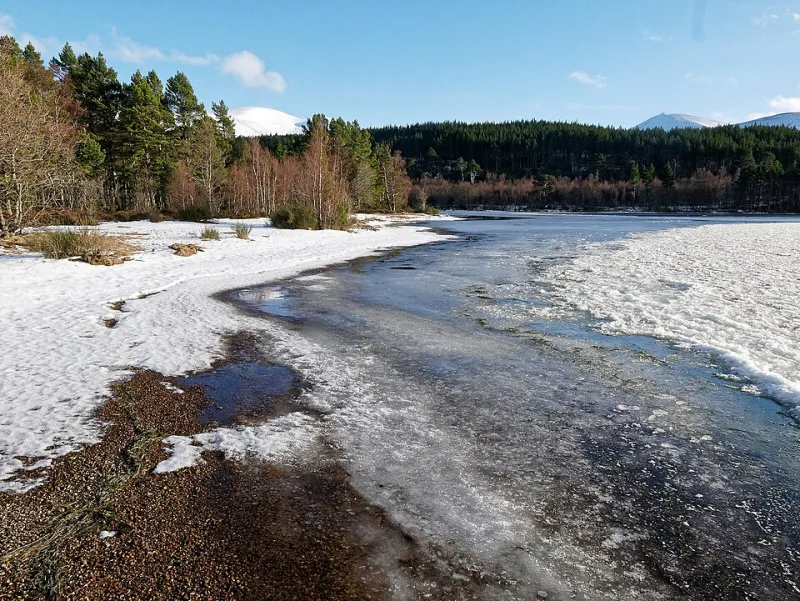
Photo: Julian Paren , CC BY-SA 2.0, via Wikimedia Commons
The first cold snap of a Trossachs winter usually arrives with a clear sky and a car park that crunches underfoot. Loch Venachar can be steaming one morning and wearing a thin skin by the next. That is the moment bank anglers start asking the wrong question: can I get out? The better question is whether the margin in front of you is worth standing beside at all.
This is not a guide to ice fishing. It is a guide to reading a frozen or half-frozen loch from the bank, making a sensible call before you tackle up, and knowing when the honest answer is to drive to another water or go home for bacon.
First look: what the car park tells you
Before you open the boot, stand still for thirty seconds. Look at the loch, not your phone. Is the surface uniformly pale, or are there dark patches? Is there open water at the inflow or along a windward shore? Are the edges crystallised and white, or glassy and dark? Has snow fallen on the ice, and if so, is it sitting on top or has it begun to slump?
A cold snap in the Trossachs is rarely tidy. Loch Katrine, Loch Achray and the smaller hill lochs all sit in different pockets of air. The water at the west end of Venachar may be open while the east end is locked. A shallow bay can freeze overnight and thaw by eleven. Treat every loch as a set of local decisions, not one big yes-or-no.
Black ice, grey ice and the soft edge
Black ice is the clear, dark-looking ice that forms when calm water freezes slowly. It looks like polished slate. It can be strong, but it can also be thin and unpredictable, especially over deeper water or where springs and inflows stir the loch. From the bank, black ice is a warning not to walk on it, not an invitation to test it. A stone thrown onto clear ice will tell you whether it is a skin or a proper lid, but the answer only matters for the margin you can see.
Grey ice is opaque, milky or white. It often forms when snow falls onto thin ice, or when the freeze is broken and refrozen. Grey ice is generally weaker and more variable than clear ice. If it looks honeycombed, slushy or patchy, keep well back. The same goes for ice that has a dull, wet sheen on top: that is a sign it is rotting, not strengthening.
Soft edges are the most common trap on Trossachs lochs. The bank absorbs sun during the day and releases it slowly. Reeds, grass tussocks and mud hold warmth. That means the ice at the edge can be thin even when the middle looks solid. A margin that holds your weight at 8am may be porridge by noon. If the ice crumbles when you poke it with a bank stick, do not stand on it, and do not assume the next yard is better.
The margin test that keeps you dry
You do not need to be a glaciologist to make a safe call. Use a long bank stick, landing net handle or walking pole. Stand well back on solid ground and tap the ice a metre or two out. Listen and watch. A sharp, ringing tap on clear ice is different from a dull thud on grey ice. If the stick goes through easily, or water wells up around the hole, the margin is not worth fishing beside.
Look for a safe standing spot first. Flat grass, a gravel bay, a jetty that is clearly sound, or a bank with a gentle slope and no undercut. Avoid steep muddy banks, submerged rocks, floating mats of vegetation and anything that looks like a recent landslip. In a cold snap, the ground itself can be slick. Studded boots or a good tread matter more than a fancy jacket.
What no ice actually means
Open water in a cold snap is not a consolation prize. It is often the better fishing. The first frost-free edge, the inflow current, the windward shore where the surface is being pushed around: these are the places where baitfish and predators stay active. If the loch is open, fish it with cold hands and low expectations, then let the water tell you whether to stay.
If only part of the loch is frozen, fish the open side and give the ice a wide berth. Do not cast onto the ice and drag the lure back over it. Do not walk out to the edge to reach a gap. A pike that takes under the ice is not a fish you can safely land from a frozen margin. Keep your feet on terra firma and your casts in open water.
Wind, snow and the refreeze
Wind is the great complicator. It breaks up thin ice, pushes it into bays and piles it against windward shores. A loch that looked locked on Tuesday can be a mess of plates and slush by Thursday. Snow insulates ice and can slow its growth, but it also hides weak patches. After snow, assume the surface is more variable than it looks.
Refreeze is another trap. A mild afternoon can soften the edge; a clear night can glaze it over again. The new skin may be an inch thick in one place and a millimetre in another. If you arrive after a hard frost following a mild day, be extra cautious around the margin. The ice has not had time to make up its mind.
A simple walk-away checklist
The best checklist is short enough to remember when your hands are cold. Use it before you tackle up.
- Can I stand at least two metres back from the ice edge on solid, level ground?
- Is the ice clear and dark, or grey, slushy, honeycombed or snow-covered?
- Does a bank stick go through the margin easily, or does water well up around the hole?
- Is there open water within a safe cast, without me needing to step onto ice?
- Is there any sign of recent thaw, running water under the edge, or cracked plates?
- Do I have a rescue plan that does not involve me going in?
If you answer badly to any of those, walk away. There is no pike, perch or trout in a Trossachs loch that is worth a soaking in near-freezing water. A cold snap is a good time to fish, but it is a poor time to gamble.
The sensible cold-morning routine
For 2026 winter sessions, make the ice call part of the drive, not an afterthought. Check the forecast for the past forty-eight hours, not just the next six. Look at overnight lows, wind direction and whether snow is due. Have a backup water in mind: a river beat, a lower loch, a sheltered bay that tends to stay open. Give yourself permission to turn around.
If you do fish beside a frozen margin, keep it simple. Fish open water. Keep your distance from the edge. Wear something that floats if you have it, and carry a phone in a waterproof pouch. Tell someone where you are. And if the ice starts to talk, creak or shift, leave. The Trossachs are at their best in winter, but they are not a playground. Read the lid, make the call, and save the ice for the view.