Feathers on the Water: A Shore-Angler's Guide to Trossachs Winter Birds
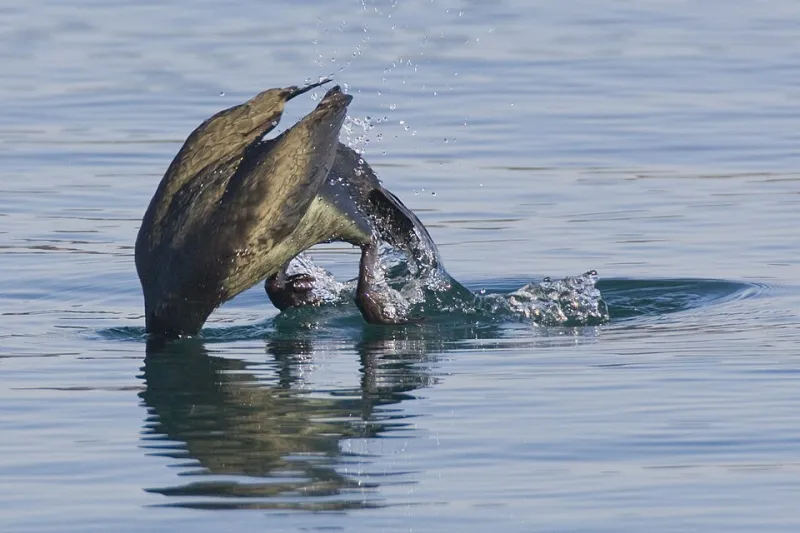
Photo: Mike Baird from Morro Bay, USA, CC BY 2.0, via Wikimedia Commons
There's a moment on a cold Trossachs bank when the fishing feels quiet, the coffee has gone lukewarm, and then a cormorant pops up fifty yards out with a small fish crossways in its beak. Everyone reaches for the rod. That's not superstition — it's free intelligence. Birds on a winter loch are often showing you where the food chain is ticking over, and where the predators underneath it might be thinking about a meal.
The trick is learning what you're actually looking at. A bird on the water is not automatically a fishing tip, any more than a raincloud is automatically a bad day. You need to separate useful behaviour from background noise, and you need to do it without turning a quiet shoreline into a wildlife chase.
Start with the Dive, Not the Drama
Cormorants are the obvious starting point because they're easy to see and their feeding style is readable. A cormorant that keeps diving in roughly the same patch is usually working a shoal of small fish, or a piece of structure that holds them. Watch the rhythm: down, up, a short pause, down again. If the bird is travelling steadily while diving, it may just be passing through. If it stays put and keeps going under, that's worth noting.
The same goes for the surface ripples. A cormorant coming up with a shake and a splash is doing you a favour — it's marking a live area. But don't assume the pike are right underneath it. They might be on the edge of the commotion, waiting for stragglers, or they might be nowhere near. The bird is telling you where baitfish are, not where your next cast has to land.
Grebes: Small Signs, Big Clues
Grebes are quieter operators. A little grebe or a great crested grebe working the shallow margins can be a useful hint on lochs like Achray or Venachar, especially when the water is cold and the fish have pulled back from the bank. Grebes tend to feed in the layer just off the drop-off, and they often work in short, busy spells rather than long patrols.
If you see a grebe repeatedly diving in one small area, pay attention to the depth and the bottom shape. On a winter bank, that might be a patch of softer weed, a small inlet, or a fold in the shoreline that holds a bit more life than the bare gravel either side. You don't need to cast at the bird. You need to cast at the kind of water the bird is using.
Gulls: Not Always the Rubbish Tip of the Loch
Gulls get a bad press, and fair enough — a flock of them squabbling over a discarded sandwich is not a fishing clue. But gulls working over open water are a different story. If they're dipping and hovering in a concentrated area, they may be picking off small fish pushed up by predators below. That's especially worth watching on breezy days when the surface is broken and baitfish are getting shoved around.
On the other hand, a gull sitting on a post for an hour is just a gull sitting on a post. Don't build a whole session around one bird's choice of perch. Look for repeated action, not a single pose.
Herons: The Patience Test
Herons are the least hurried birds on the loch, and that's exactly why they can be useful. A heron standing tight to the edge in winter is usually watching something — a slack in the current, a pocket behind weed, a bit of bank where small fish feel safe. If you see one stationed at the same spot for a long spell, it's worth noting the feature it's using. It might be a tiny bay, a culvert outfall, or a line of rushes that gives small fish cover.
But a heron can also be a red herring. They'll stand in places that look fishy to us and empty to them, and they'll happily tolerate a nearby angler if they're used to people. Use the bird as a prompt to inspect the water, not as proof that fish are queuing up.
Watch From the Bank, Not the Boat
The biggest mistake with bird-watching and fishing is getting too close. Winter birds are already burning energy to stay warm, and chasing them along the bank or rowing at them for a better look is poor form and poor fishing. Carry binoculars if you want detail. Keep your distance. Don't push a bird off its feeding patch just to satisfy your curiosity.
On Trossachs lochs, that also means thinking about access. If a bird is working a sensitive edge, give it room and fish elsewhere. There's usually another bank, another bay, another hour. The birds are not there for our entertainment, and a loch that gets hassled goes quiet fast.
When Birds Are a Red Herring
Bird activity is only a clue when it's feeding activity. A cormorant drying its wings on a buoy, a gull following a tractor in a nearby field, or a heron loafing on a jetty tells you nothing about the water in front of you. Weather matters too. A sudden drop in temperature can push birds into sheltered corners while the fish stay deep and sulky. And sometimes a bird is just working a shoal of tiny fish that no pike or perch is interested in.
Treat every bird sighting as a question, not an answer. Is it feeding? Is it repeatable? Is it near a feature you can actually fish? If not, file it away and move on.
Build a Bird Log, Not a Bird Chase
The best way to use birds on Trossachs lochs is to keep a simple note of what you see and what follows. Over a few sessions, you'll start to notice patterns: the bay where grebes always work in a cold snap, the corner where gulls gather before a weather change, the stretch where cormorants never seem to bother. That's local knowledge, and it's free.
So next time the float sits still and the hands get cold, look up. The birds might not hand you a fish, but they'll often tell you where to look — as long as you're watching from a respectful distance and thinking like an angler, not a twitcher.