Brown Plumes and Clean Seams: Reading Trossachs Burn Mouths After Rain
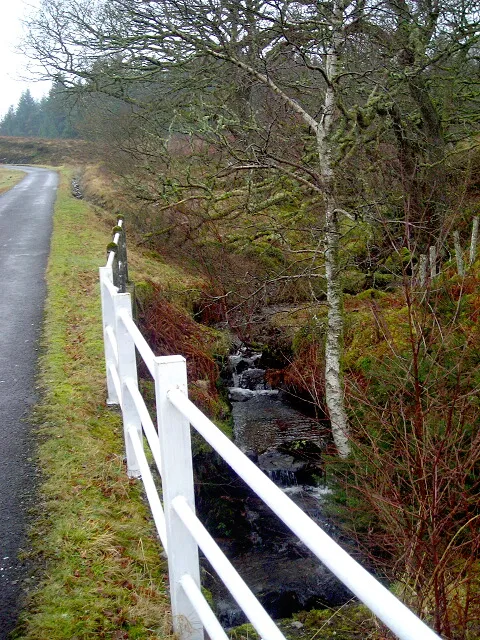
Photo: Iain Thompson, CC BY-SA 2.0, via Wikimedia Commons
Rain changes a Trossachs loch quickly. One day Loch Venachar is doing its grey, wind-ruffled thing; the next, a hill burn is pushing a brown tongue of water into the shallows and the whole bank has a different story to tell. For a winter bank angler, that dirty little fan can be the most interesting place on the water — if you read it properly and keep your feet on solid ground.
Find the fan, not just the burn
Every burn mouth is not equal. The productive ones tend to have a fan of gravel, sand and silt spreading into the loch, a clear current tongue after rain, and a decent depth change nearby. You are looking for a place where the burn has built something over time, not just a ditch trickling through mud.
On Loch Achray and Loch Chon, as well as Venachar, these fans often show themselves best when the water is low or clear. Walk the bank before you fish and look for pale gravel, scattered stones, a debris line, or a subtle bulge in the shoreline. After rain, the same spot will announce itself with colour: a plume of peat-stained water spreading into the loch and gradually thinning out.
A good inflow fan after rain is steady rather than raging. If the burn is bank-high and carrying branches, give it time. The window you want is usually after the peak, when the flow is dropping and the plume has shape — defined enough to fish, not so violent that every cast is swept away.
Read the seam from dry land
The key feature is the seam: the boundary between the dirty burn water and the clearer loch water. That line is where food, scent and temperature meet, and it is often where predators sit. But do not treat it as a single line. A plume has an inner tongue, outer edges, eddies and slack pockets behind stones or gravel bars.
Stand back and watch for a few minutes. Which way is the plume bending? Where does the current slow? Is there a back eddy on one side? Is there a clean-water pocket tucked behind the fan? Those little transitions matter more than the middle of the flow. Fish like an edge, and a burn mouth is made of edges.
Polaroids help if you have them, but even without, you can learn a lot from the surface. Ripples that break in a different direction, a slick patch, or a line of bubbles can all mark a change in current. In cold water, these small differences are worth more than a long cast into a featureless bit of loch.
Where pike and perch actually hold
Pike tend to sit on the downstream edge of the plume, or in the slack water just off the main current. They are ambush predators, not marathon swimmers. A big pike will often hold in slightly deeper, calmer water near the fan and let the current bring baitfish past. Look for the outside bend of the plume, the edge of a drop-off, or a pocket behind a gravel bar.
Perch are often closer to the current than pike, especially in winter. They will tuck into the seam itself, behind stones, or around any drowned vegetation near the fan. Smaller perch may be right in the mouth of the burn, picking off whatever washes down. If you find one, slow down and work the area properly — perch are not always spread far and wide.
Neither fish is guaranteed. A coloured burn mouth is a magnet, not a promise. If the plume is spread thin and the flow is too powerful, the fish may be further out or not there at all. Give it half an hour, watch for signs, and be willing to move.
Tactics for a coloured burn mouth
In winter, subtlety is not always your friend. A bit of colour in the water means fish may rely more on scent, vibration and silhouette. For pike, a simple deadbait fished on a leger near the seam is a sensible starting point. Keep the bait on the edge of the current rather than in the full push, and use a running lead or light breakout so the flow does not drag your rig into the next parish.
Lures can work well too, especially if you want to cover water. Choose something with a bit of vibration or a strong profile, and fish it slowly along the seam. A soft plastic or a shad-style lure worked down the edge of the plume will often get more interest than a fast retrieve through the dirty water. For perch, scale down and fish close: small jigs, dropshot rigs or a simple bait fished near cover can all produce.
Do not overcast. The fish are often within a rod length or two of the bank, especially where the fan shelves off. A quiet approach and a short, accurate cast beat a long chuck every time.
Keep it safe: the bank is the fishing platform
Inflow fans can be soft, uneven and deceptive. The gravel may look firm, but the silt around it can swallow a boot. Banks can be undercut, and a burn that is fine at lunchtime can rise quickly if there is more rain upstream. This is not a place to wade beyond your comfort zone. In fact, on a winter bank session, the safest and often most effective approach is not to wade at all.
Stay back from the immediate lip of the bank, especially after rain. Use a bank stick or walking pole to test soft ground. Keep an eye upstream and note the water level against a fixed mark, such as a stone or a stick. If the colour deepens suddenly or the flow picks up, move back and give it time. Never cross a spate burn just to reach a favourite mark.
Tell someone where you are going, carry a phone in a waterproof pouch, and have a headtorch for the short afternoons. Winter light goes quickly in the Trossachs, and a burn mouth that felt straightforward at 2pm can look very different at 4pm.
Permits and the small print
Before you fish any inflow, check the access and permit situation for that loch. Trossachs fishing is not one uniform rulebook, and some waters have specific arrangements. A quick check saves awkward conversations and helps keep these bank spots available for everyone.
The short version
After rain, look for a burn mouth with a shaped plume, a clear seam and a bit of depth nearby. Fish the edges rather than the middle of the flow. Expect pike in the downstream slack and perch closer to the current and cover. Use scent, vibration and slow presentations in coloured water. And treat the bank as your fishing platform — not a place to test your balance in waders.
Get it right and a muddy little inflow can turn a cold, quiet day into the best session of the week.