Rucksack, Rover Ticket and a River: A Car-Free Fishing Day in the Trossachs

Photo: lone angler walking with fishing rod scottish loch road autumn, via is1-ssl.mzstatic.com
There is a persistent myth that Trossachs fishing requires a car, a roof rack and a boot full of gear. It does not. Callander is a bus ride from Stirling, the lochs start within walking distance of the town, and a day pack with one rod in it will get you onto water that people with cars drive past on their way to somewhere else.
What a car-free day does demand is planning. Not much — but enough. Miss the last bus and your fishing trip becomes an expensive taxi ride. So here is the version that works.
The plan at a glance
Base yourself in Callander. It is the transport hub for the area, it has shops, toilets and somewhere to buy a coffee, and it sits within reach of a river and two lochs. One bus in, one bus out, and a walk in between.
A realistic shape for the day:
- Arrive Callander mid-morning
- Fish the river through town for an hour or two
- Walk or take the loch road out towards Venachar
- Fish the afternoon
- Back in town for the last bus
In November you have daylight from shortly after eight until roughly four, so aim to arrive around nine and be heading home by half three. Do not try to fit three venues in. Two is plenty and one done properly is better.
Getting there
From Stirling, Callander is a straightforward bus ride and the journey is short enough that you can do it on a whim. From Glasgow, there are services that put you into Callander without changing, though the timetable thins out at weekends and in winter. Check the current operator timetable the week before you go, not the morning of — some services drop to a couple of runs a day out of season.
The bus itself is easy. A rod in a cloth bag or a hard tube goes in the luggage rack without comment. Keep hooks in a box, not loose in a pocket, and you will never have an awkward conversation.
Stop one: the river through Callander
The Teith runs right past the town, and the banks around Callander give you a gentle start while you find your feet. It is not a wilderness experience — you will have dog walkers for company — but it is water, it is accessible, and it fishes well enough in autumn when the river has a bit of colour in it.
Fish it with a light spinning rod or a single-handed fly rod if that is your thing, and keep moving. Half a mile of bank covered properly is worth more than standing in one spot hoping. Before you go, confirm who holds the fishing on the stretch you fancy — the town water is not all open access, and the rules change from beat to beat.
Stop two: the loch road
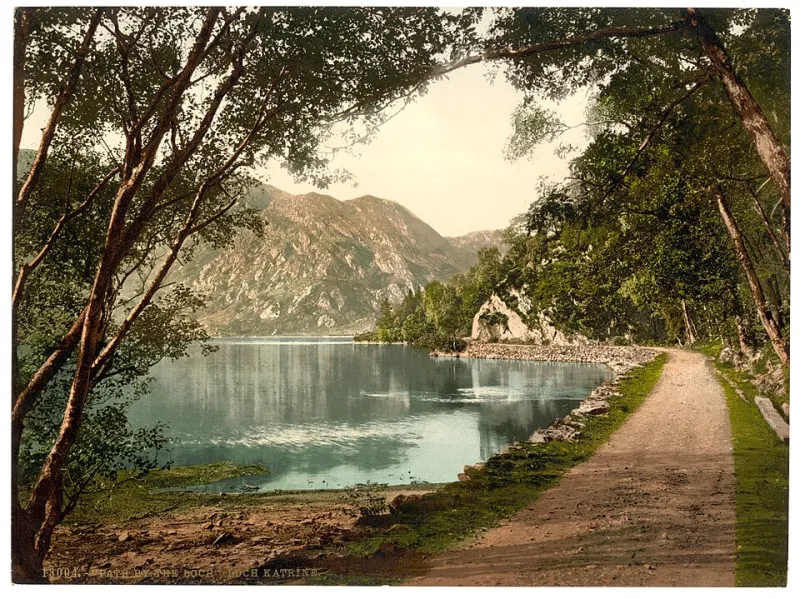
From Callander, the road up the north side of Venachar heads towards Brig o' Turk and the entrance to the Trossachs proper. There is a limited bus service along it in season, but do not build your day around it — the honest answer is that this is a walk, and a long one. Around four miles gets you to the Brig o' Turk end, which is fine if you are used to distance and carrying light.
If that sounds like too much combined with fishing, do the sensible thing: pick one venue, stay there, and enjoy it. A short taxi from town to the loch road is the pragmatic middle ground and still cheaper than running a car for the day.
The bank itself offers plenty. Rocky points, jetties and the odd pull-in give you somewhere to stand, and perch are the realistic target through late autumn, with pike possible if you are properly equipped and licensed for them. Our advice on pike bank fishing elsewhere on the site applies here — wire traces, big net, and no shortcuts.
Stop three: Achray, if your legs are willing
Beyond Brig o' Turk the road opens up towards Loch Achray, and the banks there are lovely in a dreich, atmospheric sort of way. This is the stop to drop if you are short on time or the weather turns. Achray is exposed, and a November wind funnelling down the glen will convince you of that within ten minutes.
The kit that earns its place
Pack like someone who has to carry it, not like someone loading a car boot:
- One rod, broken down, in a tube
- A small box of lures or a fly wallet
- Forceps, a compact net, and a cloth
- Waterproof jacket and overtrousers — non-negotiable in November
- Flask and a decent sandwich; the chances of finding hot food on the loch road are slim
- Head torch, even if you plan to be back before dark
- Your permit, printed or on your phone, plus a screenshot of the return timetable
That is it. A day pack of six or seven kilos leaves you free to walk, and walking is the whole point.
Permits: sort them before you board the bus
This is the bit people get wrong. Not every bank in the Trossachs is free to fish, and turning up without a permit is not a victimless mistake. Buy before you travel, online where possible, and if the permit is sold locally, check the opening hours of the shop or post office rather than discovering at 4pm that it shut at three. Our permits guide covers who controls what, and it is worth ten minutes before you plan the trip.
Timing that makes it work
Three rules keep a car-free day enjoyable rather than stressful. First, confirm the last return bus before you leave the house, and then treat it as an hour earlier than it is. Second, decide your bail-out point in advance — the moment you stop fishing and start walking back. Third, if you are on a two-hourly service, plan the day around the bus rather than squeezing one more cast in.
Do that and the lack of a car stops being a limitation. It becomes a reason to slow down, stay in one place, and actually read the water instead of racing between venues.